What can be said about filmmaker Paul Thomas Anderson that hasn’t already been said? From fawning reviews to pointed takedowns, there’s been more than enough – justified, welcomed, warmly met – criticism written about the filmmaker who may very well be our best living director currently working. I’ve read a lot of that criticism, especially the articles denouncing him as too masculine, too focused on men and their weaknesses, his lack of Bechtel test-passing stories. As much as I love reading the articles about why he’s so good – the camera angles, the synchronicity with the musical score, the firecracker acting, the sharp scripts – it’s the takedowns I love more. They challenge me to understand what it is I love about this guy’s films, and also makes me squirm and laugh a bit at people who can’t see past the meta text that’s woven through every choice. His films don’t have women so I don’t like them is an easy shot to shoot, and completely misses the obvious point that he’s making about the world in which we live out every day of our lives, the America that was founded on driven and often misguided men, and the way power – religious, political, personal – corrupts the minds of these same manly fools.
It’s hard to separate PTA from the times. His movies aren’t obviously political, though they certainly glance against (and yes, sometimes steep in) political themes. His movies aren’t ever obviously anything, even when they seem to be on first watch. He’s a filmmaker that doesn’t make anything easy, and that’s one thing I love most about the ten movies he’s directed to date. And I think that’s the thing that grabbed me first, the thing that made me keep coming back, and the thing that has only solidified these movies in my personal canon of best films.
Like many cinema enthusiasts, I first encountered PTA with Boogie Nights. I was sixteen and I didn’t get the film (which I know now but didn’t know then), even while I was transfixed by what he was doing. There’s a visceral feeling in PTA’s movies that was obvious even before I’d graduated from high school, and that roller coaster ride was enough to make me an acolyte. Boogie Nights is probably his easiest film, or at least it was easy for me (and the many many young men who I ran with who fawned over the movie). It’s a movie about taboos, so it was thrilling. It’s filled with balletic camera work, which I love. And it’s a perfect symbiosis of image and soundtrack. These are all points that I still love about his movies. There’s just nothing like a PTA movie, and Boogie Nights was the gateway drug.
If Boogie Nights was the lure floating through murky water, Magnolia was the hook that set in my cheek. I saw it in the theater in early 2000, at a time when I was at war with everything, especially the idea of family and success and what it meant to be a good person. Magnolia isn’t perfect – it’s sprawling, overstuffed, dense and inscrutable at times. But when it hits it does so with precision and brutal force, squeezing out tears that have longed to come out for years. Yes, it’s Tom Cruise’s best performance (he should have won his second Oscar – I’m a Jerry Maguire apologist, get over it). It may be the best Phillip Seymour Hoffman performance in a catalog of tightrope walking roles, any of which could be considered his peak. From its masterclass in film montages to its deft and nimble camera work, to its heart-crushing script, WTF enigmas, and sprawling cast, Magnolia casts the die for what PTA does best.
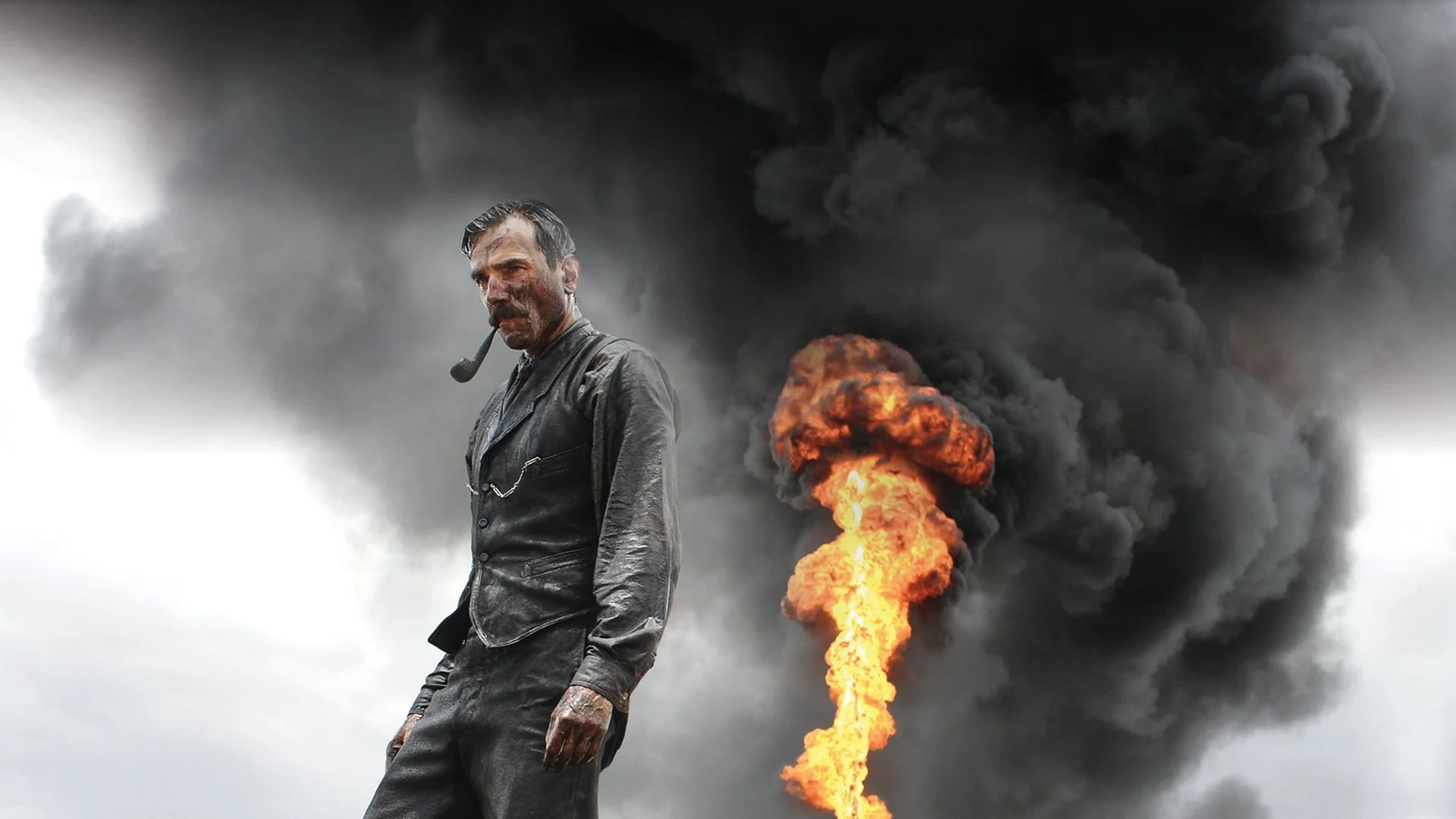
Which makes me wonder why (at least until recently, keep reading) I thought There Will Be Blood was his best? It’s so different from Magnolia in so many ways – a small cast with an almost singular focus on one character, a throwback time period, no rock and roll needle drops. Where Magnolia gives us a narrated montage to kick off the proceedings, There Will Be Blood gives us a worldless 20 minutes that perfectly sets the stage for a story about passion and determination, family and tragedy, the sacred and the profane. The montages are honed to fine points, the camera work as good as it will get, the dissonant soundtrack never missing a moment to inform the visuals. But where Magnolia leans in, There Will Be Blood almost always leans out. The plot (as thin as it is) is driven by looks, by words not spoken, by moments of absolute horror that are somehow also hilarious. It’s a demanding movie that demanded a performance that only Daniel Day Lewis could give. Good lord, it’s an amazing movie and a transfixing acting spectacle from which I cannot look away.
A blog post isn’t a great place to break down camera shots. You can find any number of great videos on Instagram or TikTok or YouTube that break down why the choices PTA makes create a sense of dread, a sense of sadness, a visceral fear. He never makes the easy choice, never shoots it the way any other director would, and those choices only make the film better than just about any other movie you could choose to watch. In one of the great jokes of the cinematic cosmos, There Will Be Blood was doomed to come out in 2007 alongside No Country for Old Men, and while DDL took home an obscenely much-deserved Best Actor Oscar and Robert Elswit nabbed the Cinematography award, PTA was left in the dust by the Coen Bros. in Directing (and Picture). I can’t argue with that. If there is a movie that challenges There Will Be Blood in the category of “movies that explain America,” it’s No Country for Old Men.
The real scandal here (in 2007) was that There Will Be Blood didn’t take home the award for Best Sound Editing (it was – somehow, how? what? – beaten by The Bourne Ultimatum.) I was lucky to see There Will Be Blood in a theater, and I’ve watched it half a dozen times at home since then. The dread I felt in that theater simply at the sound of the oil derrick’s machinery, the creaking of the rope holding the pile driver, the whip and snap when it falls and impales that poor soul down in the muck, will never possibly be replicated by even the most impressive home theater setup. There is as much going on in the sound editing as there is in the script and the movement of the camera. The Oscar voters often get things right, but they missed the boat on this one.
Pair There Will Be Blood with PTA’s newest offering and you get an interesting double bill. One Battle After Another is a tour de force in the same way as his previous tour de force nearly 20 years prior (let’s be honest, all of PTA’s movies are tours de force). But for all the similarities – passionate male main characters, family drama, elegant montages, subtle hilarity, instinctive and ingrained soundtracks – One Battle After Another takes it all and shifts it, sublimates it, and expands upon it. The perverse family drama of There Will Be Blood seems downright simplistic in comparison to the relationships PTA gives us in Bob + Willa, Lockjaw + Willa, and Perfidia + Willa. Three to one that adds up to an exponential expansion. What is subliminal in There Will Be Blood (even obscure) is more surface level in One Battle After Another, and the film is better for it, somehow, someway. The camera work is typically masterful. PTA often puts me on the edge of my seat with the way he moves the camera, but that final car chase (shot from moving vehicles with telephoto lenses – seriously look up how they did it and marvel) had me on my feet, holding back football stadium cheers. The scene where the cops light up the siren on Sensei and Bob while they’re downing beers on the way to rescue Bob’s daughter is unbelievable for the choices PTA doesn’t make. We don’t see the cars, we don’t really see the chase. The camera barely leaves the vehicle. We know the cops are there by the lights in the rear windscreen. The anxiety is ramped up ten thousand percent for what we don’t see. What we get is claustrophobic, trapped. Anyone who’s been pulled over knows the feeling, but the directorial choices expand the tension to cosmic proportions. And while There Will Be Blood is darkly funny – “I drink your milkshake!”, “I’m finished!”, just about everything Eli says and does – One Battle After Another is laugh-out-loud funny. From “A few small beers,” to the snap cut and gunshot when the vehicle pulls up alongside Lockjaw in his final moments (not mention Lockjaw’s determined zombie march back to civilization), to Bob’s burnt out attempts at remembering his password, to the Santa Claus moniker of the villainous club orchestrating the antagonism, One Battle After Another serves up as many jokes as it does moments of extreme cinematic tension. It’s like PTA took everything that worked in Boogie Nights, Magnolia, There Will Be Blood, Punch Drunk Love (should I just list all nine?), mixed them together, and baked a cinematic cake for the ages. Certainly, for the 26-year-old century.
There Will Be Blood stood at or near the top of my list of favorite movies for almost 20 years, only to be supplanted by an incredible film crafted with the same precision, the same deft choices, the same writer and director. I watched One Battle After Another on New Year’s Eve, and when the credits rolled, the only thing keeping me from starting it again was the late hour. I’m not the kid I was when I watched Boogie Nights. Thank goodness.